Inventory accuracy: the one number that proves your counts can be trusted
Every decision you make about stock (when to reorder, what to promise a customer, how much safety stock to hold) rests on a single assumption: that your records match reality. Inventory accuracy is the number that tells you whether that assumption holds, and it’s the one metric worth tracking before any other.
What inventory accuracy actually means
Inventory accuracy, often called Inventory Record Accuracy (IRA), measures how closely your records match what is physically on the shelf. If your system says 200 units and you count 200, that record is accurate. If it says 200 and you find 188, it is not. Measured across your whole catalog, IRA becomes a single percentage that sums up how much you can trust the numbers on your screen.
The two formulas
The simplest version counts records as either right or wrong:
Accuracy = (items counted correctly ÷ total items counted) × 100
A more rigorous unit and value method weighs each error by how far off it was, so a 2-unit miss matters less than a 200-unit miss:
IRA = (1 − (sum of absolute variances ÷ total units counted)) × 100
Here, absolute variance means the size of each discrepancy regardless of direction, so an item that is over by 5 and one that is short by 5 both count as 5.
A quick worked example
Say you count 5 items. Four match your records exactly and one is off. By the simple method, that’s (4 ÷ 5) × 100, or 80% accuracy. Now suppose the totals across those items came to 1,000 units counted and the variances added up to 30 units off. By the unit method, IRA = (1 − (30 ÷ 1,000)) × 100, or 97%. The unit method usually paints a more forgiving and more useful picture, because most of your stock was correct even though one record missed.
Why it matters
Low accuracy quietly taxes everything downstream. You hit stockouts on items the system swears are in stock. You carry dead safety stock to cover for numbers you don’t trust. Reorder decisions fire at the wrong time, and worst of all, a customer gets told something is available when it isn’t. Each of those is a symptom of the same root cause: records drifting away from reality without anyone noticing.
How to raise it
Accuracy improves where stock enters, moves, and gets verified:
- Tight receiving: errors that creep in at the door follow an item forever. See receiving stock the right way.
- Cycle counts: count a slice on a rolling schedule so problems surface while they’re cheap to fix. Walk through it in cycle counting.
- Count A-items more often: your high-value items deserve the most frequent checks. Use ABC analysis to decide which ones.
- Clean transfers: stock moving between locations is a common source of phantom variances, so log every move.
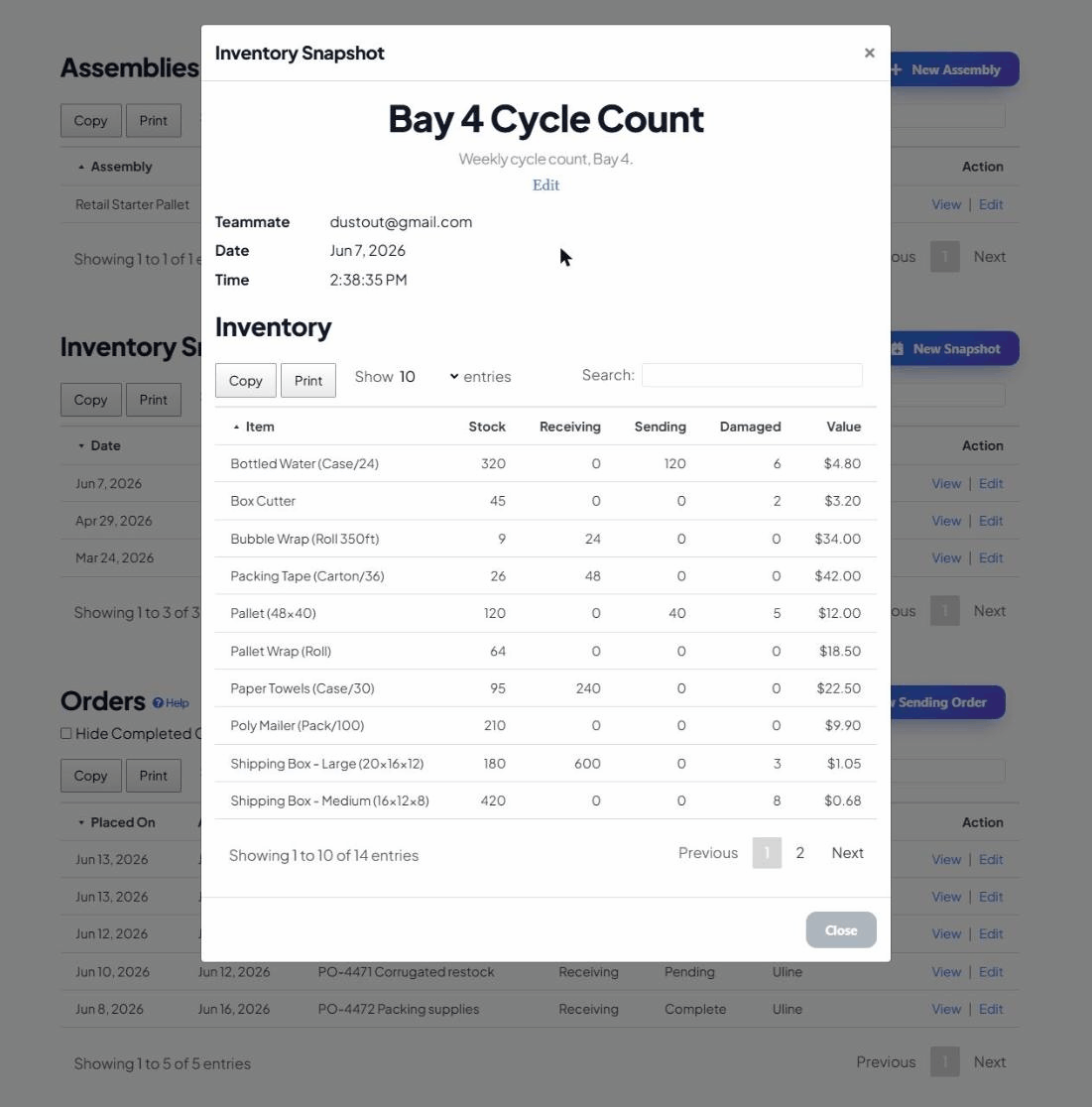
- Snapshots as a baseline: freeze a dated reference and reconcile against it. See running a stock reconciliation.
Set a target and hold yourself to it. Treat 95% as a floor, not a goal, and aim for 98 to 99% on the items that matter most.
Make measuring routine
Accuracy is only useful if you check it on a schedule. Snapshots give you a frozen baseline to count against, and full transaction history shows where a variance came from, so measuring and improving accuracy stops being a once-a-year scramble and becomes a habit. For the metrics worth watching alongside it, see inventory KPIs.