How to calculate safety stock without tying up cash
Safety stock is the extra buffer you hold so a busy week or a late delivery doesn’t leave you empty. Get it right and you absorb the bumps without panic. Hold too much and you’ve quietly parked cash and shelf space in inventory that just sits there. Here’s how to size it from your own numbers.
What safety stock is, and why it exists
In a perfect world, demand would be flat and suppliers would always deliver on the promised day. In the real world, both wobble. Safety stock is the cushion that covers two kinds of variability: demand spikes (a bigger order than usual) and lead-time slips (a delivery that arrives later than promised). It’s the difference between a small surprise and a costly stockout. If you want the full picture on what a stockout actually costs, see the cost of a stockout.
The simple method
The most practical formula uses your worst-case numbers against your typical ones:
Safety stock = (max daily usage × max lead time) − (average daily usage × average lead time)
- Max daily usage: the busiest single day of demand you realistically see.
- Max lead time: the longest a supplier has taken to deliver, in days.
- Average daily usage: how many units you sell or consume on a normal day.
- Average lead time: the typical number of days from order to arrival.
A worked example
Say an item normally sells 8 units a day, but on a busy day you’ve seen 14. Your supplier usually takes 5 days, but has stretched to 9. Plug those in: (14 × 9) − (8 × 5) = 126 − 40 = 86 units of safety stock. That’s the buffer that keeps you covered when a busy stretch and a slow delivery happen at the same time.
The more advanced method (optional)
If you want to hit a specific target service level, say covering 95% of demand scenarios, there’s a statistical version: multiply the standard deviation of demand by a Z-score for your chosen service level. It’s more precise, but it needs clean demand data and a bit of math. Most teams do fine starting with the simple method above and only reach for the service-level approach once the basics are dialed in. Seasonal lines are where this matters most, because demand swings hardest; see planning for seasonal demand.
How to avoid over-buffering
Safety stock isn’t free. Every unit you hold “just in case” is cash you can’t spend elsewhere and space you can’t use for faster-moving items. The goal is enough buffer to cover real variability, not a comfort blanket. Pull your max and average numbers from actual history rather than gut feel: usage from your transaction log, and lead times from your order history with each supplier. Then review every quarter, because demand and lead times drift. An item that needed an 86-unit buffer last spring might need half that now. Safety stock pairs with two other decisions: when to reorder, covered in setting reorder points, and how much to order each time, covered in economic order quantity.
Let the buffer enforce itself
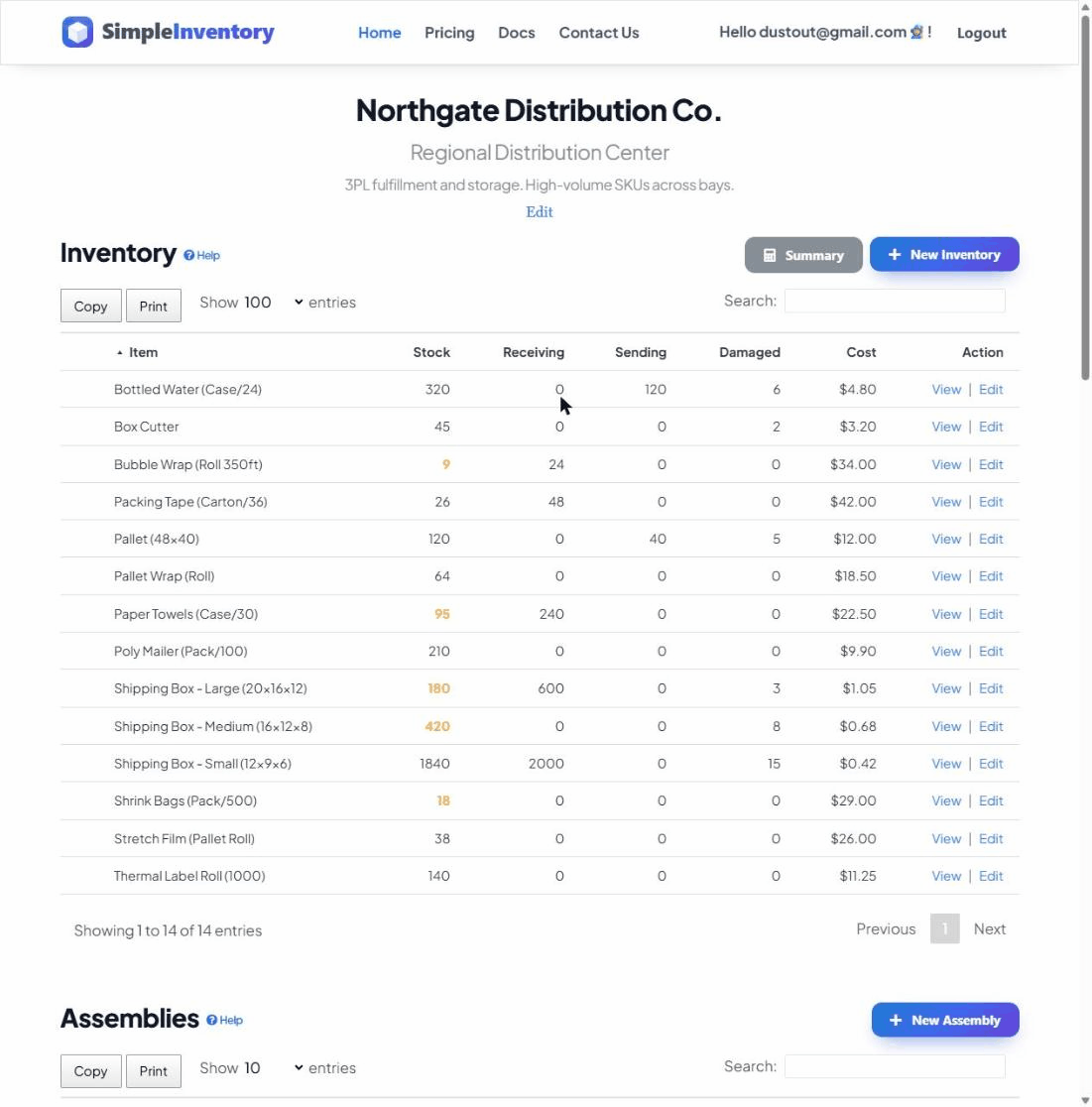
A safety-stock number only helps if someone acts on it. Instead of remembering thresholds, fold the buffer into each item: set a warning level a little above your safety stock and a critical level at it. Now low stock turns yellow, then red, on its own, and your reorder list builds itself instead of relying on a shelf walk.